2010年7月28日星期三

Japanese hand fans


The Japanese hand fans are an important symbol in Japan . They were used by warriors as a form of weapon, actors and dancers for performances, and children as a toy. In Japan fans are given to others as present and serve as trays for holding gifts. You would also find them sometimes used in religious ceremonies and events.

The Japanese believes that the top of the handle of the fan symbolizes the beginning of life and the ribs stand for the roads of life going out in all directions to bring good fortune and happiness.


Hand fans have a long history in Japan . The legends tell us the Japan was the homeland of the modern folding fan. Evidences tell us as early as the 6th century A.D. in Fukuoka , a wall painting of burial mounded showed drawings of fans. These were very similar to the Chinese style ceremonial fans that we see.

The Japanese fan was influence greatly by the oriental hand fans and was obviously modeled on during the Han Dynasty in China. In the early days, there where two types of Japanese fans, the tuan shan "round fan" and the bian mian "screen fan". The latter was any rigid fan which could be conveniently held in the hand.

Traditionally, the Japanese fans were like the Asian hand fans where it was made of feathers or silk stretch over a round or oval frame. Larger size fan made for ceremonial purposes where mounted on long pole and used by attendants in the ceremonial support of high officials at important functions or processions.

Hand fans from Japan comes in many different colors and patterns to suit the user. For example, around 1500's command troops used fans made from stick cover in black lacquer, with guards of bronze or iron which was supported by heavy paper leaf upon which displayed a sun or moon device.

Today, in traditional situation, Japanese fans play and important role as a property. Many ladies still likes to use it as a means of keeping cool in the hot weather and for performance purposes.

Chinese Fans

Like the brush pen or chopsticks, the Chinese hand fans are also an important symbol of China and one that has played an important cultural role since ancient times.

When exactly the Chinese invented hand fans is not recorded. But we do know that it was rather a discovery of the fanning function. It all started when a farmer was irritated by lots of flies and mosquitoes, he was so frustrated that he picked a big leaf with a long stem from a plant close by to drive the pests away. To his delight, his effort resulted in cooling air movements. Hence, the hand fan was invented.


It wasn't long before Asian hand fans were used in many of the imperial ceremonies and today's in many international performances that represents the Chinese tradition. More than 3,000 years ago, Chinese hand fans were made with bird's feather, which gave them more graceful and heavenly phoenixes appearance when incorporated with dance movements at imperial ceremony.

Fans become very popular in during 202 B.C.-204 A.D. in the Han Dynasty. They handles were made out of bamboo from the Central China's Hunan Province, while the best fan has surface of white silk from East China’s Shan-Dong Province.

Other then feather and silk fans, laborers used big round fans made out of grass in the summer to help to keep them cool. And in the society of aristocrats and scholars, fans were made from fine paper mounted on bamboo. Aristocrats and scholars found it interesting to paint their poetic and artistic expression on the surface. Those fans with a famous artist's painting or calligraphy would be highly prized.

Fans of aristocrats and scholars became more as a decorative tool and a symbol for them rather then the purpose of keeping them cool. They would also often wave their fans to show off their grace when composing or thinking about poetry. When fan were not used, they were concealed inside the sleeves or hung from the waist.

Today, modern oriental hand fans come in all kind of styles and material, with sandalwood fan being the most popular. Ladies who hold it gracefully in her hand are seen with elegance and femininity. This is because of its outstanding characteristic and its distinct scent coming for the wood. This subtle fragrance gives the holder an enchanting and refreshing feeling where not expensive perfume can offer.

Hand fans today are rarely use for fashion purposes throughout China, but ladies still carry them in their handbag for cooling purposes in summer and also for performances of the traditional hand fan dance.

Fan's History--Europe

Archaeological ruins show that fans were used in ancient Greece. In Europe, during the Middle Ages, the fan was absent. Christian Europe's earliest fan was the flabellum (or ceremonial fan), which dates to the 6th century. These were used during services to drive insects away from the consecrated bread and wine. Their use died out in western Europe during the Middle Ages, but continues in the Eastern Orthodox and Ethiopian Churches. Hand fans were reintroduced to Europe in the 13th century and 14th century. Fans from the Middle East were brought back by Crusaders. In the 15th century, Portuguese traders brought fans to Europe from China and Japan. Fans became generally popular.

In the 1600s the folding fan, introduced from China, became popular in Europe. These fans are particularly well displayed in the portraits of the high-born women of the era. Queen Elizabeth 1st of England can be seen to carry both folding fans decorated with pom poms on their guardsticks as well as the older style rigid fan, usually decorated with feathers and jewels. These rigid style fans often hung from the skirts of ladies, but of the fans of this era it is only the more exotic folding ones which have survived. Those folding fans of the 15th century found in museums today have either leather leaves with cut out designs forming a lace-like design or a more rigid leaf with inlays of more exotic materials like mica. One of the characteristics of these fans is the rather crude bone or ivory sticks and the way the leather leaves are often slotted onto the sticks rather than glued as with later folding fans. Fans made entirely of decorated sticks without a fan 'leaf' were known as brisé fans. However, despite the relative crude methods of construction folding fans were at this era high status, exotic items on par with elaborate gloves as gifts to royalty.

In the 17th century the rigid fan which was seen in portraits of the previous century had fallen out of favour as folding fans gained dominance in Europe. Fans started to display well painted leaves, often with a religious or classical subject. The reverse side of these early fans also started to display elaborate flower designs. The sticks are often plain ivory or tortoiseshell, sometimes inlaid with gold or silver pique work. The way the sticks sit close to each other, often with little or no space between them is one of the distinguishing characteristics of fans of this era.

In 1685 the Edict of Nantes was revoked in France. This caused large scale immigration from France to the surrounding Protestant countries (such as England) of many fan craftsman. This dispersion in skill is reflected in the growing quality of many fans from these non-French countries after this date.


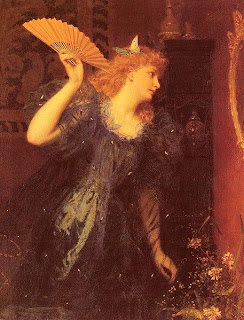
Ready For The Ball by Sophie Anderson.
Portrait by Spanish painter Diego VelázquezIn the 18th century, fans reached a high degree of artistry and were being made throughout Europe often by specialized craftsmen, either in leaves or sticks. Folded fans of lace, silk, or parchment were decorated and painted by artists. Fans were also imported from China by the East India Companies at this time. Around the middle 1700s, inventors started designing mechanical fans. Wind-up fans (similar to wind-up clocks) were popular in the 1700s. In the 19th century in the West, European fashion caused fan decoration and size to vary.

It has been said that in the courts of England, Spain and elsewhere fans were used in a more or less secret, unspoken code of messages[1] These fan languages were a way to cope with the restricting social etiquette. However, modern research has proved that this was a marketing ploy developed in the 18th century - one that has kept its appeal remarkably over the succeeding centuries. This is now used for marketing by fan makers like Duvelleroy in London who produced a series of advertisements in the 1960s showing "the language of the fan" with models displaying antique fans with this "language".


Fan's History East-- Asia


In China, screen fans were used throughout the country. The earliest known Chinese fans are a pair of woven bamboo side-mounted fans from the 2nd century BC. The Chinese character for "fan" is etymologically derived from a picture of feathers under a roof. The Chinese fixed fan, pien-mien, means 'to agitate the air'.


19th century depiction of a Japanese folding fan.
Hokusai's Five Fans.Fans were part of the social status for the Chinese people. A particular status and gender would accord a specific type of fan to an individual. During the Song Dynasty, famous artists would often be commissioned to paint picture on the surface of a fan.

The folding fan was invented in Japan in the 8th century and taken to China in the 9th century. The Akomeogi originated in the 6th century. These were fans held by aristocrats of the Heian period when formally dressed. They were made by tying thin stripes of hinoki (or Japanese cypress) together with thread. The number of strips of wood differed according to the person's rank. They are used today by Shinto priests in formal costume and in the formal costume of the Japanese court (they can be seen used by the Emperor and Empress during coronation and marriage) and are brightly painted with long tassels. The Chinese dancing fan was developed in the 7th century. The Chinese form of the hand fan was a row of feathers mounted in the end of a handle.

In China, the folding fan came into fashion during the Ming dynasty between the years of 1368 and 1644, and Hangzhou was a center of folding fan production. The Mai Ogi (or Chinese dancing fan) has ten sticks and a thick paper mount showing the family crest. Chinese painters crafted many fan decoration designs. The slats, of ivory, bone, mica, mother of pearl, sandalwood, or tortoise shell, were carved and covered with paper or fabric. Folding fans have "montures" which are the sticks and guards. The leaves are usually painted by craftsman. Social significance was attached to the fan in the Far East. The management of the fan became a highly regarded feminine art. The function and employment of the fan reached its high point of social significance (fans were even used as a weapon - called the iron fan, or tiě shān in Chinese, tessen in Japanese). Simple Japanese paper fans are sometimes known as "harisen". In Japanese current pop culture, Harisen are featured frequently in animation and graphic novels as weapons.

Printed fan leaves and painted fans are done on a paper ground. The paper was originally hand made and displayed the characteristic watermarks. Machine made paper fans, introduced in the 19th century, are smoother with an even texture.

Folding fans continue to be important cultural symbols and popular tourist souvenirs in East Asia. Geisha of all types (but maiko most often) use folding fans in their fan dances as well.

See also: Chinese paper art; gunbai

Japanese fans are made of paper on a bamboo frame, usually with a design painted on them. The fan is primarily used for fanning oneself in hot weather.

The fan symbolizes friendship, respect and good wishes. They are given on special occasions, and they are also an important stage prop in Japanese dance.

It was also used in the military as a way of sending signals on the field of battle, however fans were mainly used for social and court activities. They were used by warriors as a form of weapon, actors and dancers for performances, and children as a toy.

The fan stands for many things, the Japanese believe that the handle of the fan symbolizes the beginning of life and the ribs are for the roads of life going out in all directions

The function of hand-held fan


A hand-held fan is an implement used to induce an airflow for the purpose of cooling or refreshing oneself. Any broad, flat surface waved back-and-forth will create a small airflow and therefore can be considered a rudimentary fan. But generally, purpose-made hand-held fans are shaped like a sector of a circle and made of a thin material (such as paper or feathers) mounted to slats which revolve around a pivot so that it can be closed when not in use.


The movement of a hand-held fan provides cooling by increasing the airflow over the skin which in turn increases the evaporation rate of sweat droplets on the skin. This evaporation has a cooling effect due to the latent heat of evaporation of water.


Fans are convenient to carry around, and the folding kind in particular are compact to carry.


2010年7月25日星期日

Chinese Culture


China is one of the four ancient civilizations, Chinese civilization is the world's oldest civilizations, is one of the longest in the world civilization. Long history of Chinese civilization, if counting from the Yellow Emperor, has been 5,000 years.

Chinese culture, is also called Chinese civilization, that of Han culture. It spreaded so long ago a wide area to the concept of cultural circle,now we call it "Chinese Cultural Circle." Chinese culture impact not only Korea, Japan, Southeast Asia, South Asia, but also Philippines, Singapore, Vietnam and other countries and regions.

Ancient Chinese people were very smart and intelligent, their inventions have had a deeply impact on our. Chinese Kung Fu, dolls, opera, kites, chess, musical instruments, traditional toys, crafts and so on are deeply loved the people around of the world. I will introduce to you one by one,and hope,you will become Chinese culture lover in the future.