2010年7月28日星期三

History of the Chinese Fan Dance

The Chinese fan and its accompanying dance are cultural staples to this day. Representing skill, beauty and tradition, the Chinese Fan Dance has a long and treasured history in China.

Significance
Many Chinese fan dances began as ceremonial rituals, and while the traditional dance movements haven't changed, the uses of the dance have. Fan dances are currently a representation of beauty, grace, skill, tradition and history. Fan dances can still be used at ceremonies and Chinese celebrations (such as the Chinese New Year) and have even transformed into unique modern workouts.
The Fan
The history of the Chinese fan dates back approximately 4,000 years. It was originally used as shelter from the sun and a shield to blowing sand. Since its beginning, hundreds of types of fans have developed, including folding, feather and silk. China, known as "the kingdom of fans," has historically sold its product to Japan, Europe and the Americas. The fans were, and still are, created using materials such as bamboo, ivory, jade, bird feathers, plant leaves and various others.
Dance
The history of Chinese dance can be traced back to the fourth millennium B.C. with the Neolithic Yangshao culture. About three millennium later, the Chinese developed two types of dance, those being civilian and military. To this day, every aboriginal or minority group in China has its own form of dancing.
Types
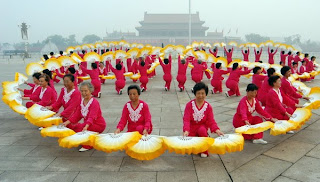
There are at least three types of Chinese dance. Traditional Chinese dance includes numerous fan dances, as well as a sword dance and dragon dance. Chinese folk dance involves the dances of minority and aboriginal Chinese groups. Chinese modern dance is an art form involving live music and movement.
Facts
The Chinese word for dance is "ou." Chinese dance became ritual in ceremonies around 2255 B.C. with the help of Emperor Shun. Chinese dance tends to focus on hand posture, having obvious masculine and feminine dance .

Fan dance --the West


A fan dance is a dance performed with one or more fans. This form has been adapted in various countries. The Korean fan dance, for example, evolved from Joseon Dynasty court dances and remains a popular form of traditional Korean dance. The Spanish or Portuguese flamenco makes dramatic use of fans. There also exists a form of fan dance in traditional Yu'pik culture in western Alaska; it bears little resemblance to the other forms represented herein.
In the West, a fan dance is often an erotic dance performance, traditionally by a woman. The performer, either entirely nude or apparently so, dances while moving two large fans, typically constructed from ostrich feathers. The essence of the choreography is suggestion, limiting the parts of the body exposed to the audience while focusing attention on illusions of exposure. Performers often evoke illusions of:
having already seen what had never been exposed, not being able to shift one's gaze fast enough to see what seems surely to be presently exposed, or being aware of currently "seeing" what in fact is not exposed to be seen. A fan dance can be viewed for erotic stimulation, aesthetic appreciation of grace and beauty, and for simple amazement of the skill of the illusion.
As of 2004, no fan dancer has been more famous than Sally Rand, who popularized it in the 1930s, remained the symbol of it throughout the middle of the 20th century, and continued to perform it beyond the age of 70.
In the UK, the fan dance has been used in the finals of the Miss Nude UK 2000 competition and in The Windmill in Soho where it replaced the tradition of nude tableaux and has since been replaced by table dancing. There have been claims that the latter has exclusive rights to it although it has also been seen at the Whitehall Theatre.

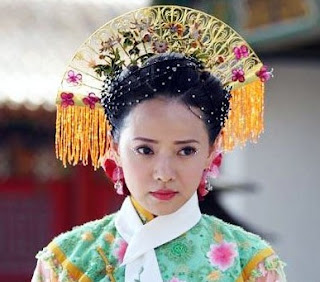
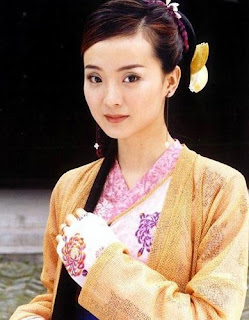
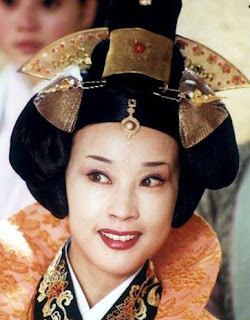
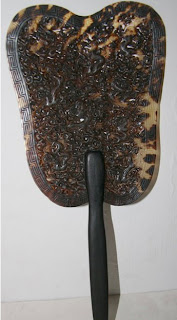
Archaian Chinese belles with fan-shaped headdress

In Chinese teleplays we often see many belles with fan-shaped headdress,now I show some for you.


1. A beautiful girl


2. This is silk fan,a little expensive


3. A gorgeous headdress


4. Small fans,can you see them?


5. Gentlewoman


6. It’s the King in the fans,so big and made of peacock feather.

Origin of the hand fan


The origin of this common and special artifact is quite uncertain. It can be assumed that the origin of the fan can be found in prehistoric times, when humans discover fire and use any kind of object to blow air and keep it alive.

Thanks to artistic representations of this object, we know that fans were used by Egyptians, Babylonians, Persians, Greeks and Romans.

From Egypt, the oldest known representation its in the head of a ceremonial hammer that can be seen at the Asmolean Museum of Oxford. It belonged to "Narmer", that around 3000 b.C. and for the first time united high and low Egypt. This representation shows a group of royal servants, two of them are slaves carrying fans.

Egyptian fans were big, fixed, and semicircular shaped, made with feathers and with long handles. Their function was double: blowing air and scaring away insects.

As time passed by, fans become an ornamental object with a distinctive meaning.

Other artistic representations on which fans appear can be found on the Beni-Hasan tombs, from the XII Th dynasty (1791 - 1796 b.C.), Rameseo sculptural works (XIX Th dynasty) and mural paintings of Medinet-Habu (XX Th dynasty).

Greeks and Romans used fans, a proof of that fact are the many literary quotes from diverse classic authors. For instance, Euripides on his Hellenic tragedy tells about an eunuch that fans Menelao's wife while she sleeps with the aim of insects not to disturb her. Other authors that mention the fan are: Menandro, Ovidio, Tibulo or Propercio on their works.

Greeks had fans of several kinds: the "miosoba", the "ripis" ans the "psigma". Romans had some kind of fans as well. "Flabellum" was the name for the most common one and "muscaria" was the fan used to scare flies.

China's centennial fan tradition starts at Emperor Hsien Yuan's time (about 2697 b.C.). A legend claims that the invention of the fan belongs to the daughter of Kan-Si. The story tells that during a mask ball and to avoid heat, she shacked very fast her mask very close to her face, so male guests could not recognize her. Her gesture was imitated by the rest of the ladies attending to the ball.

Some authors declare that the earliest archaeological proof of the existence of the fan belongs to the VIII Th century for the fixed fan in China and to the IX century for the folding fan in Japan.

In Occident, during middle Ages, the fan or "flabellum" was used during the Christian liturgy to avoid insects and refresh the believers. After the XIV Th century the flabellum fall into disuse in the roman church (except solemn masses and processions until it finally disappears after Vatican Council II), despite of this, its use was kept in Greek churches and Armenia where it was named "Rhipidion".

The fan was also known by Aztecs and Incas. Between the gifts given to Hernan Cortés by Moctezuma six feather fans were included.

In Spain the earliest references about the fan appear at the chronicles of Pedro the first of Aragón (XIV Th century). Another references of this object appear at the inventory of goods of the painter Bartolomé Abella (1429), the inventory of Prince of Viana, and the inventory of Juana the Queen in 1565 (known as Juana the madness). The fans described were semicircular fixed ones.

A feather fan was included in the gifts given by Christopher Columbus to the Catholic Queen Elisabeth after his first trip to America.


Wedding Hand Fans

The use of wedding hand fans are becoming a very popular accessories for many bride's big day. In fact brides are breaking the tradition and are replacing the traditional wedding bouquet of the brides and bride’s maids to the hand fan.

The fans have been such a common accessory for weddings because of the latest fashion trend in "Victorian" and "Vintage" looks and feeling. To follow this trends many brides have opt for a wedding gown with has lots of lace, ribbons, silk and sheer material. Instead of a wedding bouquet the fan was seen as a prefect match for these gown.


The hand fans have always been seen as an elegant fashion accessory for ladies ever since it was developed throughout the European countries. The fan was able to enhance the beauty of the user and to also add a touch of mystery. It was perfect match for any brides wedding day.

As hand fans can be used a part of the bridal party's accessory, it can so be given as a gift for your guests who attends the weddings. It is a great way to say "thank you" and to provide them will something memorable about your wedding.

Wedding fans for such purpose can be custom made to the styles and design to match the theme of a wedding. It can be made out of lace, silk, wood or paper. It can be shaped to your liking and be painted or printed with almost anything.

Spanish Hand Fans

The Hand fans represent one of the most distinct cultures of Spain. Especially in the Basques speaking regions, whose origins are lost in time and the people of Andalucia whose way of life draws heavily from the Middle East . It was understood that traders brought hand fans back from China to the Middle East
during early stages. As the Andalucia people life draws heavily from them the use of fan followed.

In contrast with the Basques of Northern Spain, the culture of Andalucia was shaped by the Moors of North Africa who crossed over to Spain during the 711 A.D. In one generation most of them intermarried with the native Spaniards. They brought with them a protective view that their wives and daughters: the women in the families were to be beautiful, discreet, and private. The hand fan, or also known by the Spanish people as 'abanico', was a perfect complement. The fan was just the right thing to provide a sense of privacy, mystery, and allure, while providing relief from the baking hot summers of Southern Spain .

During the 1400's, the Spanish people appreciated the feeling when seeing dark haired beauties gracing at the Spring Fairs of the Provinces of Granada, and Sevilla, dancing either the popular "Sevillana" or the intense and exotic "Flamenco" flashing fan in their hand.

Fans produced in Spain comes in countless sizes and designs. The cost of fans varies to the proportion to the fan size, the kind of material used as a frame (wood, metal or plastic), the type, and quality of the fabric used as webbing, and the complexity of the decoration. There are large selections of fans which are crafted on carved pear wood, with delicate cloth webbing that are hand painted with traditional designs.

Today hand fans are still used by many Spanish ladies during their hot summer as a mean of keeping cool. Also, the uses of the fans during dancing are still very popular.

Japanese hand fans


The Japanese hand fans are an important symbol in Japan . They were used by warriors as a form of weapon, actors and dancers for performances, and children as a toy. In Japan fans are given to others as present and serve as trays for holding gifts. You would also find them sometimes used in religious ceremonies and events.

The Japanese believes that the top of the handle of the fan symbolizes the beginning of life and the ribs stand for the roads of life going out in all directions to bring good fortune and happiness.


Hand fans have a long history in Japan . The legends tell us the Japan was the homeland of the modern folding fan. Evidences tell us as early as the 6th century A.D. in Fukuoka , a wall painting of burial mounded showed drawings of fans. These were very similar to the Chinese style ceremonial fans that we see.

The Japanese fan was influence greatly by the oriental hand fans and was obviously modeled on during the Han Dynasty in China. In the early days, there where two types of Japanese fans, the tuan shan "round fan" and the bian mian "screen fan". The latter was any rigid fan which could be conveniently held in the hand.

Traditionally, the Japanese fans were like the Asian hand fans where it was made of feathers or silk stretch over a round or oval frame. Larger size fan made for ceremonial purposes where mounted on long pole and used by attendants in the ceremonial support of high officials at important functions or processions.

Hand fans from Japan comes in many different colors and patterns to suit the user. For example, around 1500's command troops used fans made from stick cover in black lacquer, with guards of bronze or iron which was supported by heavy paper leaf upon which displayed a sun or moon device.

Today, in traditional situation, Japanese fans play and important role as a property. Many ladies still likes to use it as a means of keeping cool in the hot weather and for performance purposes.